

Sully at Mistral’s AI Now Summit: Balancing Sovereignty and Specialization

June 4, 2026
Insights from Olivier Audegond, our AI Solutions Manager
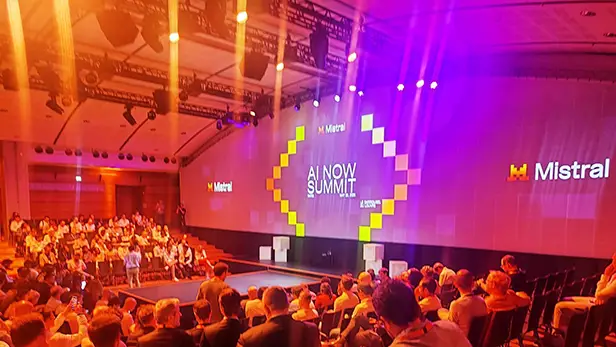
At the AI Now Summit organized by Mistral, Sully Group was on hand to gauge the major trends in artificial intelligence. Covering topics ranging from data sovereignty to specialized solutions and new applications, the event provided an opportunity to align market trends with our clients’ challenges.
Why did Sully Group participate in the AI NOW Summit?
The objective was twofold:
- First, to understand the major trends in the AI market, particularly as they relate to a French player like Mistral, which raises significant issues of sovereignty.
- On the other hand, to compare these trends with our own insights—notably as part of our AI roadmap for 2027—and with our clients’ expectations, particularly those in the public and regulated sectors.
- Finally, the event provided an opportunity to meet complementary stakeholders—software vendors, potential partners, or specialized companies—and to identify opportunities for collaboration.
How was the event organized?
The Summit was organized around three main conference formats:
- Vision Stage: strategic presentations on major market trends and announcements
- Build Stage: company case studies on real-world use cases
- Act Stage: highly technical demonstrations, which were unfortunately difficult to access due to the crowds
In total, I attended about fifteen conferences, at a very fast pace.
What lessons have you learned from this?
Three major trends have emerged.
- Sovereignty as a Key Issue
This was clearly the central theme of the event. Discussions focused heavily on data localization, infrastructure (data centers), and European partnerships. AI is no longer just a technological issue: it is becoming a strategic—and even geopolitical—issue. It is worth noting that Mistral is a French player, offering assurances in this regard compared to American giants.
- The end of generic models, making way for customization
Today, AI tools are widely accessible and produce similar results
The real differentiation now lies in the ability to adapt these models to a specific business, domain, or context. We’re talking about specialized models, advanced fine-tuning, and business adaptation. The challenge is no longer simply using AI, but aligning it precisely with real-world needs.
- AI that acts, beyond the digital realm
Another significant development: the shift from AI that “responds” to AI that takes concrete action:
Robotics controlled by natural language
Interaction with physical objects
Automation of tasks in the real world
We are witnessing a convergence between AI, robotics, and computer vision, which opens up very concrete possibilities, particularly in industry.
What made a particular impression on you?
The ubiquity of open source, an essential prerequisite for customizing models and maintaining control
The rise of on-premises AI, directly integrated into local infrastructure, to address sovereignty concerns
We are gradually shifting from cloud-based AI to AI that is managed, controlled, and contextualized.
How do these developments address our clients' challenges?
Our clients—particularly in the public sector and the energy industry—face significant constraints:
data sovereignty, security, and gradual maturity.
What this event confirms is that the adoption of AI is still recent (only a few years old), that expectations are evolving rapidly, and that maturity varies greatly from one organization to another.
In this context, the goal is not to deploy generic solutions, but to work on specific and relevant use cases.
What role does the Sully Group play in this ecosystem?
Our role remains the same… but is becoming even more critical:
- Identifying the right use cases with our clients
- Designing useful, tailored, and secure solutions
- Supporting the journey toward maturity
The goal is not to push a technology, but to offer solutions that truly create value.
In conclusion, what are the key takeaways from this event?
AI is entering a new era.
It is no longer just a software tool: it is becoming an infrastructure, an industrial driver, and a global strategic issue. But above all, one conviction is being confirmed: the key lies not in the technology itself, but in its concrete and context-specific application. That is where the real value lies.
Share